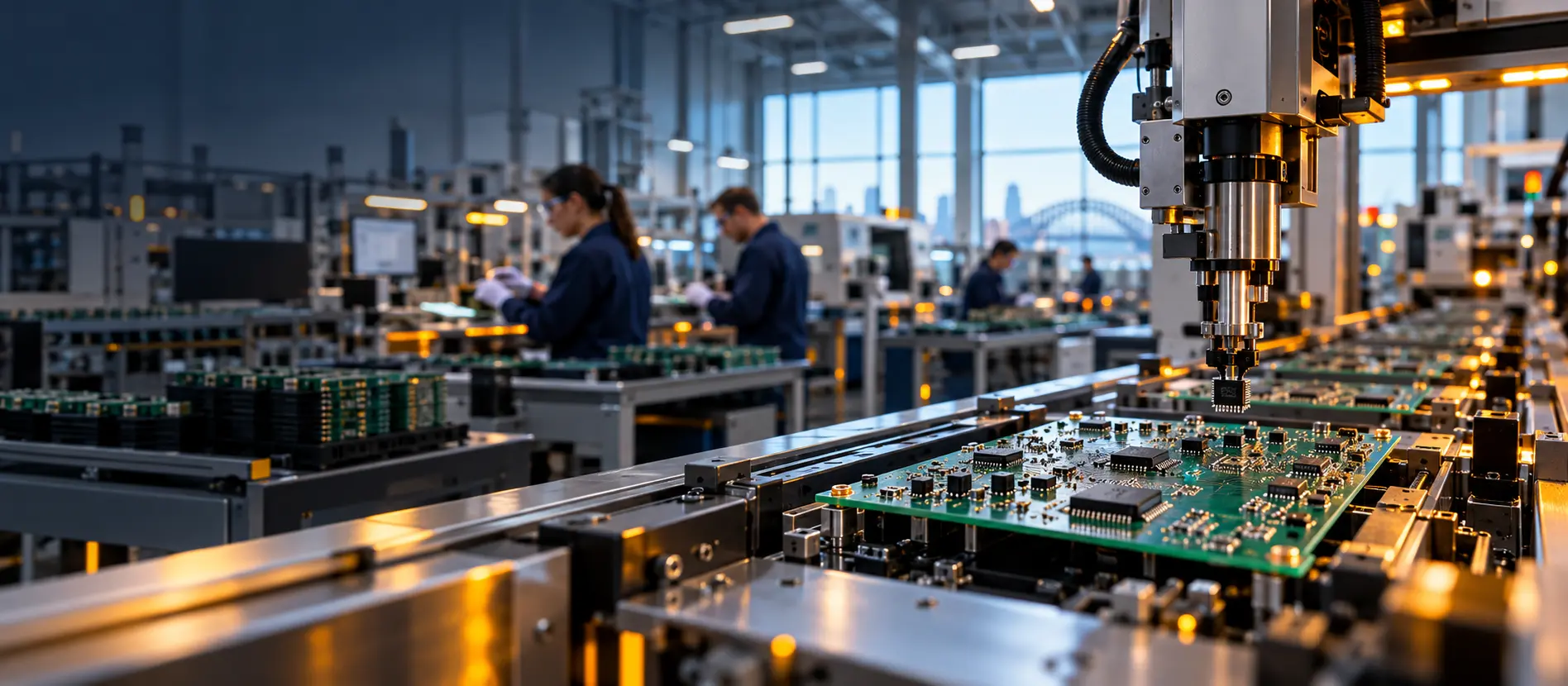
The Complete Electronics Company List in Australia — Manufacturers, Suppliers, EMS & Distributors
"Electronics company list in Australia" is really four different lists wearing one search term. A PCB assembly buyer, a component distributor's purchasing manager, an EMS provider's sourcing lead and an OEM's head of engineering are not the same contact, don't sit in the same building, and won't respond to the same message. Here's a segmented, verified directory of who's actually buying and selling across Australia's electronics ecosystem — plus a free 25-contact sample so you can see the data before you commit to it.
The gap most buyers hit isn't a shortage of companies to contact — it's that most "electronics company lists" are unsegmented exports that mix a semiconductor fab, a PCB assembler and a parts reseller into one undifferentiated spreadsheet. That's the difference between a list and a directory. A list is names in rows. A directory tells you which segment each company sits in, who the actual buyer is inside it, and what you'd realistically use that contact for.
This piece breaks Australia's electronics ecosystem into its four working segments, maps them across the country's main hubs, explains exactly how the underlying contacts are selected and verified, and walks through a real campaign built on this data — with a free sample so you can check the quality yourself before going further.
Why "Electronics Companies in Australia" Isn't One List
Ask ten different vendors what they mean by "electronics companies in Australia" and you'll get ten different buyer profiles. A test-equipment vendor wants EMS providers and OEM engineering teams. A raw-materials supplier wants manufacturers and contract assemblers. A logistics or freight-forwarding company wants distributors and importers. Treating all of them as one flat market is why so much outreach into this sector goes nowhere.
Manufacturers Buy Differently Than They Sell
An OEM is simultaneously a buyer of components and raw materials and a seller of finished products. Reaching the wrong side of that — pitching a distributor's outreach to their design engineering team — burns the contact before the conversation starts.
Component Suppliers Have Their Own Buying Committee
A distributor's purchasing manager cares about supply continuity, lead times and price breaks — not the engineering specs an OEM's design lead would ask about. Same industry, completely different conversation.
EMS Providers Sit Between Two Worlds
Contract manufacturers buy components at volume for other companies' designs and sell assembly capacity back to OEMs. A generic pitch to "electronics manufacturing" misses which side of that transaction you're actually trying to reach.
Distributors Are the Fastest-Moving Segment
Wholesale distributors and resellers turn over contacts and stock lines quickly. A distributor list that isn't refreshed within a few months is often already missing the procurement lead who replaced the one it was built around.
The question isn't "does this company work in electronics." It's "which side of an electronics transaction does this contact sit on, and does my message match that side." Everything else about targeting follows from getting that one distinction right.
— P2B Services B2B Data Intelligence, 2026Australia's Electronics Ecosystem, Segmented by Who Actually Buys and Sells
Four segments cover the vast majority of the commercial activity in Australia's electronics sector. Each has its own firmographic profile, its own procurement role, and its own realistic use case for outreach.
Segment 01 of 04
Electronics Manufacturers (OEMs)
📌 Design, Own and Sell Their Own Branded ProductsThis segment covers companies that design and manufacture their own electronic products — from industrial sensors and instrumentation to consumer electronics, telecommunications hardware, medical devices and defence electronics. Australia's OEM base is concentrated but technically sophisticated, with particular depth in industrial automation, defence and medical device electronics.
Firmographic Profile:
- Company size: ranges from 20-person specialist design houses to established manufacturers with several hundred staff
- Typical procurement roles: Head of Engineering, Procurement Manager, Supply Chain Director, R&D Lead, Operations Manager
- Buys: raw materials, semiconductors, PCBs, test equipment, EMS/assembly capacity, compliance and certification services
- Sells to: distributors, direct enterprise or government buyers, export markets
Segment 02 of 04
Electronic Component Suppliers & Distributors
📌 Source and Resell Parts to Manufacturers and AssemblersThis segment sources semiconductors, connectors, passive components, PCBs and sub-assemblies from global manufacturers and resells them into Australia's OEM, EMS and repair markets. Many operate as authorised distributors for major global component brands alongside independent stocking distribution.
Firmographic Profile:
- Company size: from small independent stocking distributors to national branches of global distribution groups
- Typical procurement roles: Purchasing Manager, Inventory & Supply Chain Manager, Branch Manager, National Sales Manager
- Buys: components at volume from manufacturers, logistics and warehousing services, inventory management systems
- Sells to: OEMs, EMS providers, repair and maintenance businesses
Segment 03 of 04
EMS & Contract Manufacturing Providers
📌 Build, Assemble and Test Products on Behalf of Other CompaniesElectronics Manufacturing Services (EMS) providers handle PCB assembly, box-build, testing and sometimes design-for-manufacture on behalf of OEMs that don't run their own production lines. Australia's EMS sector is smaller than Asia's high-volume players but is competitive on low-to-mid volume, quick-turn and defence/medical-grade work where local production and compliance matter.
Firmographic Profile:
- Company size: typically 20–200 staff, with a smaller number of larger, defence-accredited facilities
- Typical procurement roles: Operations Director, Sourcing/Procurement Lead, Quality Manager, Business Development Manager
- Buys: components at volume, assembly and test equipment, quality/compliance certification, factory software and MES systems
- Sells to: OEMs across defence, medical, industrial and telecommunications sectors
Segment 04 of 04
Wholesale Distributors & Resellers
📌 Move Finished Electronic Products Into Trade and Retail ChannelsThis segment covers wholesalers and resellers moving finished electronic products — consumer electronics, industrial equipment, security and networking hardware — into trade, retail and B2B channels, rather than raw components into manufacturing. It overlaps with Segment 2 in some categories but is distinct in buying finished goods rather than parts.
Firmographic Profile:
- Company size: from regional trade wholesalers to national distribution networks
- Typical procurement roles: Category Manager, National Purchasing Manager, Channel/Partnerships Manager
- Buys: finished products at wholesale volume, warehousing and 3PL services, channel marketing support
- Sells to: retailers, installers, system integrators, trade customers
Australia's Electronics Hubs — Mapped by Segment Strength
Geography changes which segment dominates and what those companies actually specialise in. A national list without hub-level filtering hides this — treating a Melbourne industrial electronics manufacturer and a Perth mining-electronics distributor as interchangeable "Australia" contacts.
Melbourne, VIC
Manufacturing & EMS DensityThe largest concentration of electronics manufacturers and EMS providers nationally, with strength in industrial, automotive-adjacent and instrumentation electronics.
Sydney, NSW
Distribution & Corporate HQHome to the largest share of component distributor head offices and national distribution/reseller networks, alongside a growing electronics design and R&D base.
Brisbane, QLD
Growth SegmentA smaller but expanding base of manufacturers and EMS providers, with increasing activity tied to renewable energy and industrial electronics.
Adelaide, SA
Defence & Automotive ElectronicsPunches above its size for defence-accredited EMS and manufacturing, plus a legacy automotive electronics supply base transitioning into broader industrial work.
Perth, WA
Industrial & Mining ElectronicsDistributors and manufacturers oriented around mining, resources and industrial automation electronics — a distinct buyer profile from the eastern-seaboard hubs.
National Coverage
All Segments, All HubsP2B's Australia electronics database spans all five hubs plus regional pockets, filterable by segment, hub and procurement role in a single build.
Selection & Verification: How Companies and Contacts Make This Directory
A directory is only as useful as the process behind it. Here's how P2B selects and verifies the companies and contacts behind this Australia electronics database.
Selection & Verification Process:
- Segment classification — every company is categorised into manufacturer, component supplier/distributor, EMS provider or wholesale distributor before it enters the database, not left as an unclassified "electronics" tag
- Business registration check — company registration and active-trading status confirmed against public registry data
- Role-level contact matching — contacts are matched to the procurement or decision-making role relevant to their segment, not just any employee at the company
- Email deliverability validation — every contact is verified for deliverability before inclusion, cutting hard-bounce risk before a campaign ever sends
- Rolling re-verification — records are re-checked on a rolling cycle rather than exported once and left to decay, since contacts and roles turn over fastest in the distributor segment
What This Looks Like in a Real Campaign
A test and measurement equipment vendor came to P2B wanting to reach EMS providers and OEM engineering leads across Melbourne, Sydney and Adelaide — three hubs with three different technical buyer profiles. The generic "Australia electronics" list they'd used previously mixed distributors and retailers into the same send, producing a reply rate too low to build a forecast around.
P2B built a custom list limited to EMS providers and OEM engineering/procurement leads specifically across Melbourne, Sydney and Adelaide — dropping distributors and resellers entirely from the send.
Every contact was validated for current role and email deliverability before the send, keeping hard bounces low enough to protect the sending domain's reputation for future campaigns.
P2B's managed email campaign service ran two distinct message tracks — one for EMS Operations Directors, one for OEM engineering leads — instead of a single generic pitch to both.
The segmented, role-matched send produced a materially higher qualified-meeting rate than the client's prior unsegmented list — the outcome of matching each message to the actual buyer on the other end, not a bigger contact count.
The underlying lesson holds regardless of what you're selling into this market: the segmentation and verification work has to happen before the first email goes out. No amount of copywriting fixes a list that puts the wrong message in front of the wrong buyer.
The 5 Mistakes That Waste an Australia Electronics Company List
❌ Mistake 1: Buying an unsegmented "electronics" export. A list that doesn't distinguish manufacturers from distributors from EMS providers forces one generic message onto four different buying processes — and it shows in the reply rate.
❌ Mistake 2: Skipping the sample before committing. Without a sample, you're trusting a vendor's word on data quality. A real 25-contact sample lets you check role accuracy and formatting before paying for the full build.
❌ Mistake 3: Treating a one-time export as permanent. The distributor and EMS segments turn over contacts fastest. A list that isn't re-verified within a few months is already missing the person who replaced the one it was built around.
❌ Mistake 4: Ignoring hub-level differences. A Perth mining-electronics distributor and a Sydney consumer-electronics wholesaler have almost nothing in common as buyers. Filtering only by "Australia" hides that distinction.
❌ Mistake 5: No compliance check on the source. Outreach into this market needs to meet Australia's Spam Act and Privacy Act requirements. Confirm the data provider's compliance guarantees before running a campaign on a purchased list, not after.
Frequently Asked Questions — Electronics Company List Australia
Melbourne and Sydney hold the largest concentration of electronics manufacturers, component distributors and EMS providers, followed by Brisbane, Adelaide (strong in defence and automotive electronics) and Perth (mining and industrial electronics).
A manufacturer (OEM) designs and sells its own branded electronic products. A component supplier or distributor sources and resells parts — semiconductors, connectors, PCBs — to other companies. An EMS provider is a contract manufacturer that builds, assembles or tests electronic products on behalf of another company's design.
A properly verified list cross-checks company registration status against public registry records, confirms the named contact still holds the listed role, validates the email address for deliverability, and re-verifies records on a rolling cycle rather than a one-time export.
Yes. Point To Business Services provides a free 25-contact sample list from the requested segment and region so buyers can verify data quality and formatting before committing to a full list build.
A compliant list is built for legitimate business-to-business outreach with role-relevant contacts, a clear opt-out mechanism, and adherence to Australia's Spam Act and Privacy Act requirements. Always confirm the provider's compliance guarantees before using a list for outbound campaigns.
Ready for a Segmented Electronics Company List Built for Your Offer?
P2B Services supplies hyper-validated contacts across Australia's electronics manufacturers, component suppliers, EMS providers and distributors — segmented by hub and procurement role, backed by compliance guarantees, and available as a bespoke list build with managed outreach as a next step.
Request Your Free Sample →An electronics company list in Australia is only as useful as the segmentation and verification behind it. Manufacturers, component suppliers, EMS providers and distributors each have a different buying process, a different procurement role to reach, and a different message that actually lands — and geography changes the profile again within each segment.
That's the standard this directory was built to. Reach out to P2B Services today and discover how our B2B mailing lists and B2B lead generation solutions can put a verified, segment-ready electronics company list to work for your next campaign in Australia.
Recent Blogs
-
How to Penetrate into
West African Market and the Strategies? -

How is technology changing
the insurance industry? -

Why Nurse Email Lists Are Essential
for Healthcare Marketing -

How to Effectively Pitch
Marketing Services to Doctors -

How to Choose the Best
B2B Mailing List :7 Essential Qualities -

How Blockchain Changing
the Banking Sector ? -

10 Most Popular Software’s
Used in Healthcare -
How AI is Transforming Businesses
in the Oil and Gas Industry -
Seven Proven steps to Retain Customers
with customer win-back campaigns -

Learn Essential Sales negotiation
skills and strategies to win more deals! -
Missing out on quick sales? Unlock
the mystery of transactional selling! -
What Is Lead Nurturing
and Why Is It Important ? -
35 Essential Sales Terms
you need to know -
The Essential Guide to C-suite
Marketing? Tips & Strategies -

Top 10 Fastest Growing Industries
for 2024 in the United States -
Why Human Resources
Management is Important? -

How to Use the 5 Senses to
Increase Sales in Retail Industry -
What Is Data Cleansing, Why Is
It Important, And How Can You Do It? -

10 Effective Marketing Strategies for
Food & Beverage Industry -

Best Marketing Strategies & Tips for
Oil & Gas Industry Sector -

Why Email Marketing is very effective
for Healthcare Businesses -
Top 10 Most Effective Fintech
Marketing Strategies for 2024 & Beyond -
Effective Email Follow Up
Strategies To Get More Sales -
Best ways to Segment
B2B Target Audiences -

The 5 cutting-edge waves of
innovations shaping tomorrow -

Best Strategies for Effective
Email Marketing in The Aviation Industry -
Best Practices to Grow
Your B2B Podcast -
Generating B2B Leads on
LinkedIn – Strategies for 2023 -

B2B Email Marketing: Best Practices
& Proven Strategies -
Prospecting vs Lead Generation
-
A Guide to Outbound Lead Generation
Strategies That Work -

Top 5 B2B Lead Generation
Companies in India -
What is Data Validation
and Why is it Important? -

Top 10 Healthcare
Data Providers & Companies in 2023 -
5 Effective Partnership Email
Templates for B2B Businesses -
Why Data Verification is Crucial
for Decision-Making and Strategy ? -

What companies use AWS ?
-
A Complete Guide to Creating
a B2B Database -

Learn How to Create Visually
Attractive Emails -

How to Generate More Leads for
Your Travel Business ? -

8 Ways to Get Real Estate Agents’
Email Address Easily -
How ERP is Capitalizing
Business Management in Industries ? -
The Ultimate Guide to B2B
Manufacturing Marketing Strategy -
How to Write best B2B
Email Subject Lines -

Effective B2B Lead Generation
Tips for Sales Success! -
Pros & Cons of Buying an Email
List for Your Business in 2023 -

How To Acquire Clients for
Your Transport Business -
Understanding Data Licensing in 2023
-
HR Manager’s Email Address
How to Find It -
How to Pitch Retailers
Through Email -
Email Marketing
B2b Lead Generation -

How To Find
CEO Email Addresses -
How to Write Effective
B2B Emails -

How to Plan And
Deliver The World Class Summit in 2023 -

How To Reach
Top Business Decision Makers Easily -
Best Guide to
B2B Demand Generation in 2023 -

How to Build & Scale
Your Consulting Business -

How to Pitch and Sell with a CFO
-
How can I get a list of ceo email address
-

Top 13 travel & Tourism
email list providers in the World -
How To Find And Buy
A B2B Email List 
The Ultimate Guide for
data appending in 2022-

9 best techniques
for your event marketing strategy 
Marketing Strategy Of
The Automobile Industry
9 Reasons To Buy
For Manufacturing Industry Email List
How To Grow Your Email Database 2022
-

Email Marketing Tips
That Will Get You More Leads -

B2B Lead
Generation Strategy Trends for 2022 -
10 Reasons
Why You Will Love B2B Email List -

Want to Know All Things About Events?
You Need To Read This First 
Best Way To Improve Your
Marketing And Sales-

COVID-19 Effects on
Small Businesses & How to overcome -
How Do We Improve Your Brand Growth
-

How Accurate Email Data
can improve your Prospecting process
Post Your Comment

Recent Posts
How to Build a Sales Pipeline in Malaysia's Data Centre & AI Infrastructure Market
How to Build a B2B Cold Email Campaign That Actually Converts — 2026 Complete Guide
Technology & Digital Infrastructure: The 4 B2B Sectors Driving $2.5 Trillion in 2026
How to Build a B2B Contact Database for APAC in 2026: A Step-by-Step Playbook
Taiwan's Hidden B2B Opportunity: Beyond Semiconductors
The $4.7T B2B Opportunity in Singapore & Taiwan You Can't Ignore
How To Build a Sales Pipeline to Get More Deals?
How to Choose the Best B2B Mailing List: 7 Essential Qualities
B2B Email Marketing: Best Practices & Proven Strategies
Archives
September 9, 2026
Tags
- Electronics Company List Australia
- EMS Providers Australia
- Component Distributors
- B2B Data Verification
- APAC B2B Lists
- Manufacturing Lead Generation
Category
- B2B Data & Databases
- Lead Generation
- Manufacturing & Electronics
- Sales Outreach
 8296439334